Vadzo Imaging Validates Innova-662CRE Sony STARVIS 2 IMX662 2MP GigE Camera with HDR Imaging for Smart Traffic Monitoring
The Innova-662CRE is a 2MP color rolling shutter GigE Vision camera built on the Sony STARVIS 2 IMX662 sensor and
Press Release Disclaimer: This is a press release distributed through the XPR Media network. It has not been independently verified by our newsroom.


The Innova-662CRE is a 2MP color rolling shutter GigE Vision camera built on the Sony STARVIS 2 IMX662 sensor and engineered for smart traffic monitoring deployments. Gigabit Ethernet with Power over Ethernet lets a single Cat5e or Cat6 cable carry both power and data up to one hundred meters from a roadside camera to the nearest network cabinet, removing the short cable run limitation that makes USB and MIPI camera products impractical for pole-mounted traffic infrastructure. The STARVIS 2 sensor’s wide dynamic range handles the backlit and high-contrast scenes common at intersections, tunnel entrances, and toll booths, resolving vehicle and license plate detail in both bright sky and shadowed roadway within the same frame. Native GigE Vision compliance means the camera integrates with standard machine vision software without a proprietary capture card. Designed for OEMs and system integrators building traffic monitoring, tunnel, bridge, and toll infrastructure, the Innova-662CRE gives traffic camera deployments the cable distance and dynamic range that roadway conditions demand.
CHICAGO, IL / ACCESS Newswire / September 25, 2026 / Vadzo Imaging, a provider of embedded vision camera products for OEMs and system integrators, today announces validation of the Innova-662CRE IMX662 2MP GigE Camera, a 2MP color rolling shutter camera built on the Sony STARVIS 2 IMX662 sensor and engineered for smart traffic monitoring. Part of Vadzo’s GigE Vision camera portfolio, the Innova-662CRE pairs the IMX662’s wide dynamic range pixel architecture with Gigabit Ethernet connectivity, giving traffic infrastructure integrators a camera that runs over a single Power over Ethernet cable up to one hundred meters from the nearest switch, without the short cable runs that constrain USB deployments or the co-location requirement that constrains MIPI deployments. With this validation, Vadzo delivers a 2MP HDR Gigabit Ethernet Camera that resolves both bright sky and shadowed roadway detail in the same frame, giving traffic engineers, tunnel operators, and toll authority integrators a camera platform ready for direct integration into intersection, tunnel, bridge, and toll infrastructure without a proprietary capture card or short-range cabling constraint.
Technical Problem Definition
Traffic monitoring camera systems almost always sit somewhere a compute rack does not: on a signal mast arm at an intersection, inside a tunnel bore, on a bridge structure, or at a toll gantry positioned meters or tens of meters from the nearest equipment cabinet. USB camera products are electrically limited to a few meters of cable run without an active extender, and even extended USB links introduce reliability concerns in an outdoor, vibration-prone, electrically noisy roadside environment. MIPI camera modules face an even tighter constraint, since the sensor must sit within centimeters of its host processor, which forces the entire compute platform onto the pole or gantry alongside the camera rather than allowing it to sit in a climate-controlled cabinet at ground level. Traffic engineers who need a camera thirty, fifty, or a hundred meters from their nearest cabinet have historically had to choose between running expensive fiber media converters, accepting an active USB extender’s reliability compromises, or mounting compute hardware in an outdoor enclosure it was never designed to occupy. Traffic scenes present a second problem independent of cable distance. An intersection camera looking west at sunset faces a bright sky directly behind oncoming vehicles. A tunnel entrance camera must resolve a dark tunnel bore against a bright daylight exterior within the same field of view. A toll booth camera must read a license plate lit by oncoming headlights at night without losing detail in the surrounding dark roadway. A standard dynamic range sensor forced to choose a single exposure setting for these scenes either blows out the bright sky and headlights to white or crushes the shadowed vehicle and roadway detail to black, and either failure mode defeats the vehicle identification and license plate reading that the camera was installed to perform in the first place. Traffic authorities operating a network of dozens or hundreds of camera locations feel both problems compounded at scale: every camera that needs an active USB extender or a relocated compute enclosure adds recurring maintenance cost, and every camera that misses a detection or a plate read during a backlit or nighttime period represents a gap in the very safety and enforcement function the network exists to provide.
Engineering Explanation
The Innova-662CRE addresses the cable distance problem through native GigE Vision connectivity with Power over Ethernet. A single Cat5e or Cat6 cable carries both gigabit data and camera power up to one hundred meters, which covers the overwhelming majority of pole-to-cabinet and gantry-to-cabinet distances found in real traffic infrastructure without a media converter, an active extender, or relocating compute hardware to the pole itself. GigE Vision is an established machine vision standard, so the camera integrates with standard third-party GigE Vision software on the host side rather than requiring a proprietary capture card or driver stack, and the underlying gigabit Ethernet link tolerates the electrical noise and cable routing conditions typical of outdoor infrastructure runs better than an extended USB link does. On the dynamic range side, the Sony STARVIS 2 IMX662 is a 1/2.8 inch back illuminated CMOS sensor with a 2.9-micron pixel pitch and native 2MP (1920 x 1080) resolution. STARVIS 2 pixel architecture combines high quantum efficiency for extreme low-light sensitivity with an on-chip HDR mode that captures a wide dynamic range within a single frame interval rather than merging multiple sequential exposures after the fact. This matters directly for an HDR Imaging GigE Sensor operating at an intersection or tunnel entrance, where a sequential multi-exposure HDR technique would introduce ghosting artifacts on the moving vehicles that are the actual subject of interest, while single-frame HDR capture avoids that problem entirely. A GigE HDR Traffic Sensor of this design also benefits from the interface choice itself, since gigabit Ethernet delivers the bandwidth a wide dynamic range sensor needs at full frame rate without the compression artifacts a lower bandwidth link would introduce. An HDR Enhanced Ethernet Camera built this way resolves both a bright sky and a shadowed vehicle interior within the same exposure, which keeps a license plate readable even when it sits directly in front of a strong backlight source, and the same HDR Wide Range GigE Camera architecture extends that benefit to nighttime scenes where headlight glare would otherwise overwhelm a standard dynamic range sensor. Rolling shutter readout is appropriate for the moderate vehicle speeds typical of intersections, tunnels, and toll booths, where the IMX662’s dynamic range advantage over standard sensors matters more than the motion freezing that a global shutter would add at meaningfully higher cost. The camera is rated across a -40 degree C to 85 degree C operating range, matching the extreme outdoor temperature swings that pole-mounted and gantry-mounted traffic camera systems experience across a full year of exposure.
Product Overview
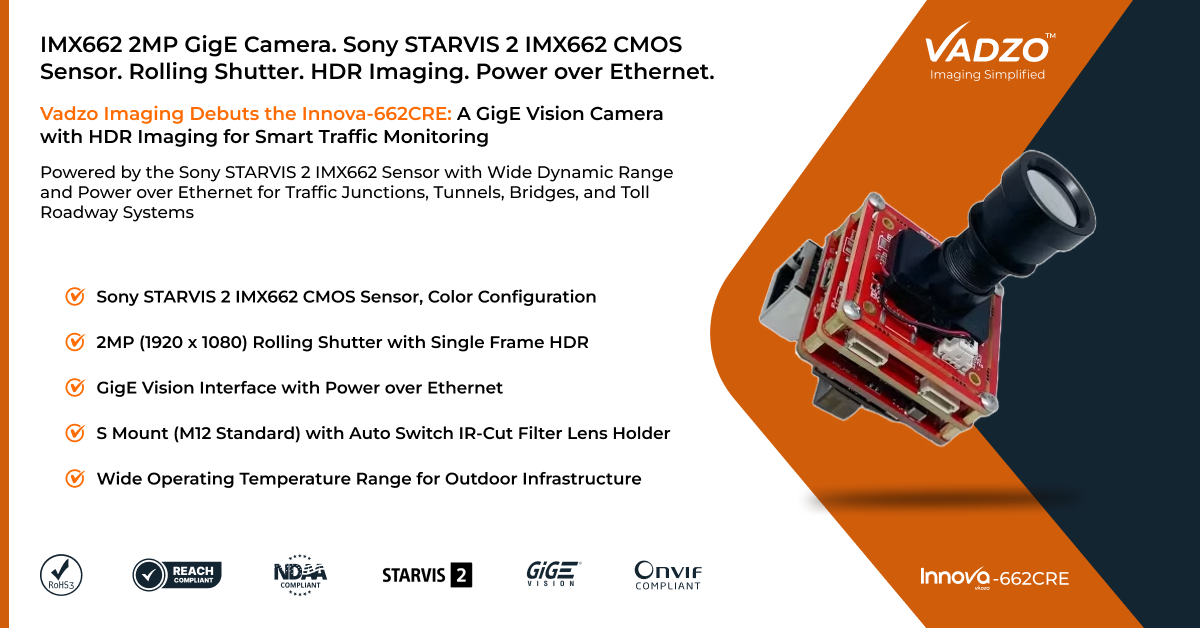
The Innova-662CRE is an IMX662 2MP GigE Camera built on the Sony STARVIS 2 IMX662 sensor and paired with native GigE Vision connectivity engineered specifically for traffic monitoring infrastructure. As a Sony STARVIS 2 IMX662 GigE Camera, it is purpose-built for OEMs who need a camera that can sit far from its host compute equipment without sacrificing image quality in high-contrast roadway scenes. The Sony IMX662 HDR Ethernet Camera designation reflects Vadzo’s validation of the IMX662 sensor’s HDR mode specifically for the backlit and high-contrast conditions traffic camera systems encounter daily, confirming exposure behavior, dynamic range performance, and GigE Vision compliance before the module reaches OEM customers. The camera module houses the IMX662 sensor, ISP, and Gigabit Ethernet controller with Power over Ethernet in a compact form factor with a standard S-Mount (M12) lens holder that accepts interchangeable optics for varying mounting heights and fields of view. As a 2MP HDR Ethernet Sensor platform, the camera presents a standard GigE Vision interface to host software, requiring no proprietary capture card for evaluation or production integration.
Key specs: 2MP (1920 x 1080) | Sony STARVIS 2 IMX662 1/2.8 inch 2.9-micron pixel | Color | Rolling Shutter | GigE Vision with Power over Ethernet | Cat5e/Cat6 up to 100 meters | S-Mount (M12) | -40°C to 85°C
Key Capabilities of the Sony STARVIS 2 IMX662 HDR Gigabit Ethernet Camera
2MP HDR Resolution for Wide Dynamic Range Traffic Scenes: Many traffic camera products still rely on standard dynamic range sensors that force an installer to compromise between exposing for the bright sky or the shadowed roadway, never both. The Innova-662CRE, positioned as an IMX662 2MP HDR GigE Camera, captures a full 2MP (1920 x 1080) frame with wide dynamic range in a single exposure, resolving both a bright sky and a shadowed vehicle within the same image. This makes it a 2MP GigE HDR Module suited to intersection approaches where the camera faces directly into morning or evening sun, and a 1080p HDR Traffic Camera capable of holding usable detail across the full brightness range a roadway scene presents rather than only the portion a standard dynamic range sensor can capture.
GigE Vision Interface for Long Distance Pole Mounted Deployment: Traffic infrastructure rarely places a camera within a few meters of its host compute equipment, which is exactly the distance USB camera products are limited to without an active extender. The Innova-662CRE, validated as an IMX662 2MP HDR Ethernet Camera, removes that constraint entirely through native GigE Vision connectivity, running over a single Cat5e or Cat6 cable up to one hundred meters. This makes it a 2MP Wide DR GigE Camera that traffic engineers can mount on a signal mast, gantry, or tunnel wall at the distance the installation requires, rather than the distance a USB cable happens to reach.
Sony STARVIS 2 Sensor Architecture for Low Light and Backlit Conditions: Traffic monitoring runs continuously across dawn, daylight, dusk, and full darkness, and a sensor tuned only for daylight performance leaves gaps in coverage exactly when incident response and enforcement most depend on a usable image. The Innova-662CRE’s Sony STARVIS 2 IMX662 sensor was engineered specifically for extreme low-light sensitivity alongside its HDR mode, making the camera an HDR Vision Ethernet Sensor that maintains usable detail as ambient light drops toward nighttime levels rather than requiring supplemental illumination at every installation site. This dual capability directly benefits an HDR Backlit Traffic Camera role, since the same sensor architecture that resolves a bright sky against a shadowed vehicle during the day also resolves headlight glare against a dark roadway at night. Traffic networks that previously needed separate daytime and nighttime camera tuning profiles can standardize on a single exposure strategy across the full day and night cycle, since the sensor’s combined low-light sensitivity and HDR mode cover both extremes without a manual handoff between settings.
HDR Imaging for Backlight Compensation and Headlight Glare: Backlit vehicles and headlight glare are the two conditions most likely to defeat a standard dynamic range traffic camera, since both present an extreme brightness difference between the light source and the vehicle or plate the camera actually needs to resolve. The Innova-662CRE’s single-frame HDR capture functions as a Traffic Backlight Compensation Camera without introducing the ghosting artifacts a sequential multi-exposure HDR technique would produce on moving vehicles. This makes it a practical HDR Roadway Vision Camera for any installation where the sun, an oncoming headlight, or a bright exit from a tunnel bore sits directly behind the subject the camera needs to identify.
Power over Ethernet for Simplified Traffic Infrastructure Wiring: Roadside camera installations typically require both a power feed and a data connection run to every camera location, which doubles the cabling work and the number of failure points across a traffic network. The Innova-662CRE eliminates that duplication through Power over Ethernet, delivering both power and gigabit data over the same Cat5e or Cat6 cable run. For a GigE Vision HDR Traffic Kit deployment spanning multiple intersections or a tunnel’s full length, this single cable approach reduces the conduit and cabling work required at every camera position, and it simplifies maintenance since a technician troubleshooting a camera has only one cable run to trace rather than separate power and data paths. Installation crews wiring a new intersection or retrofitting an existing tunnel can budget one cable pull per camera position rather than coordinating separate electrical and data contractors, which shortens the installation timeline for larger traffic network buildouts.
OEM Integration for Traffic and Smart City Programs: The Innova-662CRE ships as a complete GigE Vision camera module rather than a bare sensor, giving traffic and smart city OEMs a validated starting point instead of an open-ended integration project. Available as an HDR Traffic Camera Kit for evaluation, the camera lets traffic engineering teams confirm HDR performance and cable run distance on their own infrastructure before committing to a production order. For OEMs evaluating Vadzo as an OEM HDR Traffic GigE Module supplier, this means lens matching, firmware customization, and enclosure design support are available alongside the core camera hardware rather than as a separate engagement. Vadzo’s track record as an HDR Traffic Camera Supplier covers production programs spanning multiple sensor families and interface types for OEM customers building smart city and traffic infrastructure products.
“Traffic camera installers keep telling us the same two things. First, the camera almost never sits close enough to the cabinet for USB to work, and running a media converter or an extender at every pole adds cost and another failure point. Second, the exact scenes that matter most for identification- a vehicle backlit by a low sun, a plate lit by headlights at night- are the scenes a standard dynamic range sensor handles worst. The Innova-662CRE was built to answer both problems directly. By pairing the Sony STARVIS 2 IMX662 with native GigE Vision and Power over Ethernet, we give traffic engineers a camera that runs a hundred meters on one cable and still resolves the backlit, high-contrast scenes that roadway conditions produce.” – Alwin Vincent, Product Manager, Vadzo Imaging.
Application Specific Sections
Traffic Junction and Intersection Monitoring: Intersection camera installations face some of the most demanding lighting conditions in traffic monitoring, since a mast arm mounted camera often looks directly into a low morning or evening sun while still needing to resolve vehicles and pedestrians in the shadowed portion of the same frame. The Innova-662CRE functions as an HDR Traffic Junction Camera for these installations, using its HDR mode to hold detail across the full brightness range an intersection presents, while GigE Vision with Power over Ethernet lets the camera sit on the mast arm at whatever distance the intersection geometry requires from the traffic controller cabinet.
Traffic Signal and Vehicle Detection Systems: Signal timing and vehicle detection systems depend on a camera that reliably distinguishes vehicles from roadway background across changing light conditions throughout the day. As a GigE Traffic Signal Camera, the Innova-662CRE gives signal system integrators consistent detection input regardless of whether the intersection is backlit by morning sun, evenly lit at midday, or illuminated only by headlights and streetlights after dark, reducing the false detections that a standard dynamic range camera introduces under changing lighting.
Tunnel Monitoring: Tunnel entrances present one of the most extreme dynamic range challenges in traffic monitoring, since a camera positioned to monitor tunnel traffic must resolve the dark tunnel bore and the bright daylight exterior within the same field of view. The Innova-662CRE serves as an HDR Tunnel Traffic Camera for this exact scenario, and its Power over Ethernet connectivity suits the long cable runs typical of tunnel installations, where camera positions can sit well beyond the reach of a standard USB cable from the tunnel’s equipment room. Tunnel operators can position camera units at intervals dictated by coverage requirements rather than by cable length constraints, since a single Cat5e or Cat6 run reaches the full one hundred meter distance the GigE Vision interface supports.
Bridge Monitoring: Bridge structures place camera hardware at fixed points that are often difficult and costly to run separate power and data cabling to, particularly on longer spans where the nearest equipment room may be a significant distance from the camera’s optimal vantage point. The Innova-662CRE operates as an HDR Bridge Monitoring Camera for these installations, with Power over Ethernet reducing the bridge structure’s cabling requirement to a single run per camera, and HDR imaging resolving the high contrast between open sky and shadowed structural elements that bridge monitoring installations commonly face.
Vehicle Detection and Toll Roadway Systems: Toll booth and open road tolling systems need to reliably identify vehicles and read license plates regardless of the time of day or the angle of ambient light relative to the lane. The Innova-662CRE functions as a GigE Vehicle Detection Camera for these systems, and its HDR performance directly benefits an HDR Toll Booth Camera role, where headlight glare at night and low sun angles at dawn and dusk are a routine part of the lighting conditions the camera must handle without a missed read. Toll authorities running open road tolling at highway speed depend on consistent plate legibility across every lighting condition a lane can present over a full day and night cycle, and a camera that only performs well in even midday light leaves a coverage gap precisely during the transition hours when glare is most severe.
Frequently Asked Questions
Q: Why does Vadzo Imaging recommend a GigE camera for traffic monitoring installations?
A: Vadzo Imaging designs its traffic camera lineup around where these camera units actually get installed, which is rarely within easy cable reach of a compute cabinet. Vadzo Imaging validates its traffic camera products with native GigE Vision and Power over Ethernet specifically so that a single cable can carry both power and data across the distances typical of signal masts, tunnel walls, and bridge structures. Vadzo Imaging positions this interface choice as a practical response to how traffic infrastructure is actually built, not a generic feature checklist item.
Q: How does Vadzo Imaging’s HDR camera handle bright sunlight and vehicle headlights in traffic scenes?
A: Vadzo Imaging selects sensors with a single-frame HDR mode for its traffic camera lineup specifically because traffic scenes routinely present both a bright light source and a dark subject within the same frame, whether that is a low sun behind an intersection or headlight glare against a dark roadway at night. Vadzo Imaging’s HDR approach captures the full brightness range in one exposure rather than merging several sequential frames, which avoids the ghosting artifacts that a multi-frame technique would introduce on moving vehicles. Traffic engineers evaluating this capability can request a sample unit directly from Vadzo Imaging to confirm HDR performance against their own intersection or roadway lighting conditions before finalizing a deployment.
Q: Can Vadzo Imaging’s traffic camera run over long cable distances from the nearest network cabinet?
A: Yes. Vadzo Imaging’s traffic camera lineup uses Gigabit Ethernet with Power over Ethernet, which carries both power and data over a single Cat5e or Cat6 cable up to one hundred meters. Vadzo Imaging designed this specifically for traffic infrastructure, where a camera mounted on a signal mast, gantry, or tunnel wall is routinely much farther from its equipment cabinet than a standard USB cable could reach.
Q: Is Vadzo Imaging’s traffic camera built to handle outdoor weather conditions?
A: Yes. Vadzo Imaging rates its traffic camera lineup across a wide operating temperature range to handle the outdoor temperature swings that pole-mounted and gantry-mounted camera installations experience throughout a full year. Vadzo Imaging validates this environmental performance specifically for traffic and smart city deployments, where a camera installed on infrastructure is expected to operate reliably through summer heat and winter cold without a service visit.
Q: Why should smart city integrators choose Vadzo Imaging as their traffic camera supplier?
A: Vadzo Imaging offers more than a validated camera module. Smart city integrators working with Vadzo Imaging receive engineering support covering lens selection, firmware customization, and enclosure design guidance alongside the core camera hardware. Vadzo Imaging maintains evaluation kits with no minimum order requirement, so traffic engineering teams can confirm HDR performance and cable run distance on their own infrastructure before committing to volume production. This combination of validated hardware, long-distance connectivity, and low minimum evaluation access is why smart city integrators continue to choose Vadzo Imaging for traffic camera programs.
Availability
The Innova-662CRE IMX662 2MP GigE Camera built on the Sony STARVIS 2 IMX662 sensor is available now for evaluation and production orders. Evaluation kits include the camera module, S-Mount lens, Power over Ethernet injector, and GigE Vision configuration documentation, with no minimum order requirement. Browse the full Smart Traffic Camera lineup at Vadzo’s website or contact Vadzo at support@vadzoimaging.com to request an evaluation unit or discuss OEM integration requirements for traffic, tunnel, bridge, and toll camera programs.
About Vadzo Imaging
Vadzo Imaging is a global provider of embedded vision solutions and delivers high-performance camera technologies and imaging platforms for applications in robotics, industrial automation, UAVs, edge AI, and medical systems. Its products are designed for seamless integration with leading embedded platforms. Vadzo supports customers through hardware customization, firmware development, and module-level drivers, enabling faster development and deployment of vision-based systems across GigE, USB, MIPI, Wi-Fi, and SerDes camera interfaces.
Media Contact
Alwin Vincent
Vadzo Imaging
Email: alwin@vadzoimaging.com
LinkedIn: Vadzo Imaging
YouTube: Vadzo Imaging
X: Vadzo Imaging
SOURCE: Vadzo Imaging
View the original press release on ACCESS Newswire
Media gallery