History comes alive in Guizhou as Chinese and Vietnamese youth find shared memories, new friendships and inspiration for future exchanges
Just another WordPress site
Press Release Disclaimer: This is a press release distributed through the XPR Media network. It has not been independently verified by our newsroom.
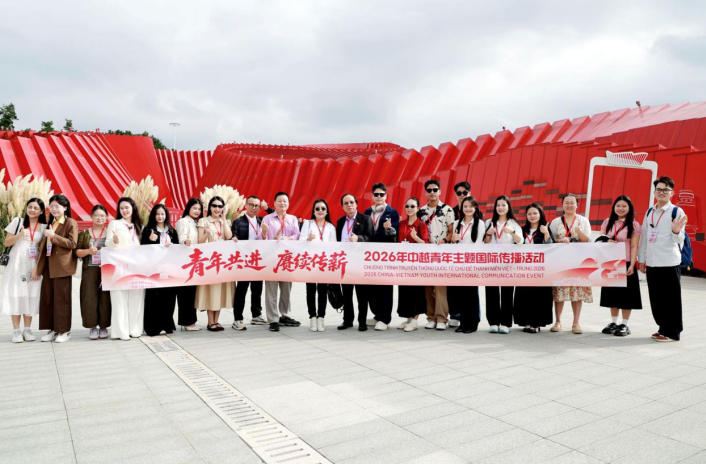

Guizhou, China – September 28, 2026 – Before visiting China, 23-year-old Vietnamese student Ma Thi Diem Huong knew the Long March (1934-36) mainly as a phrase from history books. She understood little of what its spirit meant. But after experiencing an immersive performance in Guizhou province, chapter of Chinese history had moved from the page into something she could feel and understand.
“If I had only known it through words, I would never have felt the Long March so close to my heart,” Ma said.
Ma was among more than 40 young people, experts and media representatives from China and Vietnam who took part in the 2026 China-Vietnam Youth International Communication Event, organized by 21st Century Media and Education in Guizhou from Sept 17 to 21.
The five-day program took participants to sites associated with the Long March while also offering a look at contemporary China through visits focused on technology, industry and rural development.
For Ma, the journey into Chinese history began at the Guizhou Long March Culture Digital Art Museum, known as the “Red Banderole”, a Red culture-themed immersive venue in Guiyang, Guizhou.
There, holographic projections brought the faces of Red Army soldiers who took part in the Long March into view. As Ma tried to make out the images more clearly, actors portraying Red Army soldiers quietly appeared beside her.
Some crawled across the ground to recreate the harsh conditions faced during the Long March, while others unfurled a flag symbolizing victory and passed it over the heads of Ma and other audience members.
One scene in particular transformed Ma’s curiosity into a deeper emotional understanding of the Long March.
In a re-creation of the Battle of the Xiangjiang River, one of the bloodiest and most costly battles of the Long March, Ma watched young Red Army soldiers — some her age or even younger — press forward as comrades fell around them.
For Ma, their decision to keep moving despite the danger gave concrete meaning to a spirit she had previously encountered only in books.
“Now I can finally understand why the Long March is called the journey of greatness,” she said.
The experience also led Ma to think about how new forms of storytelling can make distant history more accessible to people from different cultural backgrounds.
Through immersive technology, live performance and historical re-creation, she said, a story that had once felt abstract became immediate and memorable.
“An immersive Long March story is really like a hook, sparking curiosity about Chinese history in people from different cultural backgrounds,” she said.
A living bond
Ma’s experience was deeply personal, but the sense of historical connection extended beyond her. For other Vietnamese participants, learning about the Long March also evoked memories of their own country’s historical struggles and the values shaped by them.
Among the program’s activities was The Great Turning Point, a live performance in which actors portrayed ordinary Red Army soldiers during the period of the Zunyi Conference.
For Nguyen Thi Le Ngoc, deputy director of the Institute for the Preservation and Promotion of Vietnamese Ethnic Culture, the performance was one of the most moving experiences of the trip.
A veteran performing artist herself, Nguyen stepped onto the stage and joined the actors. At one point, she gently helped a young woman portraying a Red Army soldier straighten her braid. At another, she stood beside a male actor as he raised his fist in a gesture symbolizing revolutionary conviction.
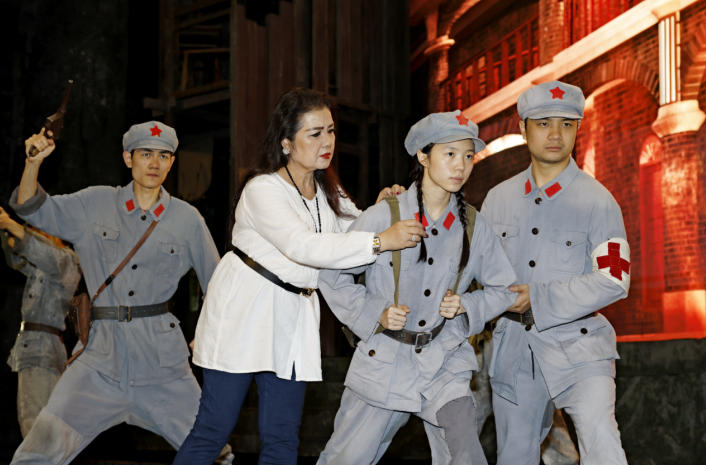
Through the performance, Nguyen felt she was no longer simply observing the Long March from a distance. More importantly, the experience prompted her to reflect on parallels between the historical experiences of China and Vietnam.
She said the Long March reminded her of the national spirit demonstrated by the Vietnamese people during periods of hardship and national defense.
“Although Vietnam and China have different historical experiences, we both value ideals, patriotism, solidarity, the will to overcome difficulties, and the aspiration for a better life,” Nguyen said.
If Nguyen found a connection between the two countries through shared historical experiences, younger participants encountered an even more tangible link at the Zunyi Conference Memorial Museum.
There, Chinese student Zhu Lin, 25, was drawn to a photograph among the museum’s many images documenting the Long March. It showed Vietnamese General Nguyen Son, also known in China as Hong Shui, who took part in the Chinese Red Army’s Long March.
After learning more about his life, Zhu came to see him not simply as a historical figure, but as a link between the two countries and their peoples.
Standing beside her, young Vietnamese participant Vuong Thi Nguyet Anh was also moved by his story and began sharing what she knew about his life in Vietnam.
Their conversation gradually shifted from history to contemporary life. In that moment, a historical figure connecting China and Vietnam became the starting point for a present-day exchange between two young people eager to understand each other better.
“We talked about education and traditional culture in China and Vietnam as socialist countries. It made me feel there is so much we can learn from each other,” Zhu said.
The exchange, however, was not designed solely to look back at history.
As the journey moved from Red culture sites to technology centers, factories and villages, participants also had opportunities to observe different aspects of China’s contemporary development.
These visits broadened the trip from revolutionary history to questions of technological innovation, environmental protection and rural development.
For 22-year-old Vietnamese participant Le Van Dai, that shift left a particularly strong impression.
During a visit to a tire factory, Le paid close attention to a system designed to reduce pollution during the manufacturing process. Seeing the system in operation gave him a more concrete understanding of China’s efforts to balance industrial development with environmental protection.
“This small detail shows the wisdom of China’s ecological civilization,” he said, adding that such practices could offer useful lessons for similar industries in Vietnam.
Later, during a visit to an ecological village, Le was struck by something different: young people who had returned from major cities and were using skills such as digital marketing for agricultural products to contribute to local development.
Seeing young Chinese people bring their professional knowledge back to their hometowns prompted him to consider whether similar ideas could inspire young people in Vietnam.
For Le, the value of the five-day journey lay not only in what he had seen in China, but also in what he hoped to take home and share with others.
“By gaining a deeper understanding of China, I am more determined to become a small bridge, sharing what I have truly seen in China with young people in Vietnam,” Le said, adding that he hopes to return to China in the future.
About 21st Century Media and Education
The 21st Century Media and Education is a public institution directly affiliated with China Daily. It mainly undertakes international communication and education responsibilities for Generation Z, and strives to build a Sino-foreign youth exchange platform integrating publicity, culture and education.
Media Contact
Company Name: 21st Century English Education Media
Contact Person: Yin Yanqing
Email: Send Email
Country: China
Website: https://www.i21st.cn/