Fastino Labs Releases GLiDE, the First Thinking Decision Model, Leading the Decision Index’s Top Model by 6.9 Points
SAN FRANCISCO, Oct. 1, 2026
Press Release Disclaimer: This is a press release distributed through the XPR Media network. It has not been independently verified by our newsroom.

Fastino Labs Releases GLiDE, the First Thinking Decision Model, Leading the Decision Index’s Top Model by 6.9 Points
PR Newswire
SAN FRANCISCO, Oct. 1, 2026
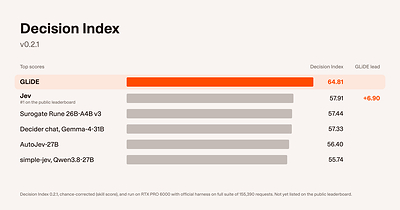
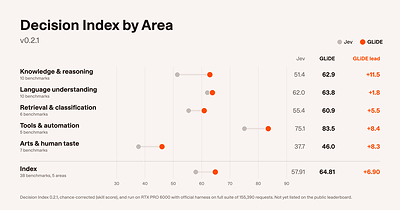
SAN FRANCISCO, Oct. 1, 2026 /PRNewswire/ — Fastino Labs, the applied AI research lab behind the widely adopted open source GLiNER model family, today released GLiDE (Generalized Lightweight Decision Engine), the first decision model with adaptive reasoning. In Fastino Research team’s runs of the official Decision Index 0.2.1 scorer, GLiDE scores 64.81, leading Jev’s published 57.91 by 6.90 skill points. GLiDE outperforms Jev across all five evaluation areas and on 31 of 38 benchmarks. GLiDE is available today via the Fastino API.
As AI agents take on real work, the hardest part is often not generating text but deciding what to do next: which tool to call, whether to ask for approval, or when to stop. Most systems handle these choices by prompting a large general-purpose model and parsing its output, which is slow, expensive, and hard to trust in production. Existing decision models are faster, but they score every option in a single fixed pass, which breaks down when the right answer depends on arithmetic, code, dates, or several related facts. GLiDE is built to handle both.
Structured Decisions:
GLiDE takes an application’s current state and a defined set of options, then returns one selected action, a confidence score, and a probability for every option. Because the output is structured, developers can act on it immediately, set confidence thresholds, or route uncertain cases to a human, without parsing or validating free-form text.
Adaptive Thinking:
Every decision starts with a fast first pass. When GLiDE is confident, it answers right away. When it isn’t, it thinks further and folds that reasoning into its final probabilities. In testing, roughly two-thirds of requests were resolved on the fast path, with reasoning reserved for the remaining third. Easy decisions stay fast, and hard ones get the compute they need.
Built for Hard Decisions:
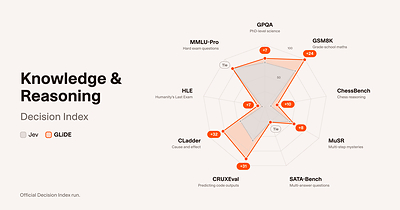
GLiDE’s biggest gains over Jev come on reasoning-intensive tasks and tool use. It leads by 11.5 skill points in Knowledge and Reasoning (62.9 vs 51.4) and 8.4 points in Tools and Automation (83.5 vs 75.1). On CRUXEval, which tests code reasoning, GLiDE scores 92.6% accuracy versus Jev’s 73.0%, and on CLadder, which tests causal reasoning, it scores 88.7% versus 72.6%. Its 40,000 token context window fits full policies, contracts, runbooks, and support histories.
“We think decision-making will become its own layer of the AI stack, much as retrieval has. You shouldn’t need to call a frontier model every time an agent needs to choose its next step. GLiNER has passed 50 million downloads, and GLiDE is our best decision model yet. It handles routine choices quickly and can think through the harder ones.” said George Hurn-Maloney, CEO and co-founder of Fastino Labs.
Use Cases:
GLiDE handles the everyday classification and routing tasks served by existing decision models while extending to decisions that require deeper reasoning. Any application that combines context with a defined set of choices can use the same interface. Straightforward decisions remain fast, while uncertain decisions automatically receive additional reasoning.
- Navigating large agent action graphs. Select the next action from hundreds of tools and possible paths while accounting for prerequisites, previous results, permissions, failure states, and downstream consequences.
- Controlling high-risk agent actions. Evaluate a proposed database, infrastructure, or financial operation against the agent’s permissions, organizational policies, system state, and potential impact before deciding whether to execute, sandbox, request approval, or block it.
- Diagnosing production incidents. Combine alerts, logs, recent deployments, dependency health, and runbook instructions to choose among monitoring, restarting, rolling back, isolating, or escalating.
- Applying complex contracts and policies. Trace cross-references, exceptions, dates, thresholds, and conflicting clauses to determine whether a claim should be approved, rejected, revised, or escalated.
- Verifying reasoning-intensive model output. Check answers that depend on arithmetic, temporal reasoning, code execution paths, causal relationships, or multiple supporting facts, then decide whether to accept, reject, or request revision.
- Resolving constrained operational decisions. Choose among predefined plans using scheduling requirements, eligibility rules, resource limits, configuration dependencies, and competing priorities.
Availability:
GLiDE is available now through the Fastino API under the model ID fastino/GLiDE. Get started and see pricing at docs.fastino.ai.
About Fastino Labs
Fastino Labs is an applied AI research lab building small open weight models and the infrastructure to make them continuously better in production. Founded in 2024 and based in San Francisco, California, Fastino is the creator of the GLiNER open source model family and the first agentic fine-tuning and adaptive inference platform. The company is backed by Khosla Ventures, Insight Partners, M12, NEA, and others. Learn more at fastino.ai.

 View original content to download multimedia:https://www.prnewswire.com/news-releases/fastino-labs-releases-glide-the-first-thinking-decision-model-leading-the-decision-indexs-top-model-by-6-9-points-302896638.html
SOURCE Fastino Labs